Applying Carbon Dots to Alleviate Photoinhibition and Boost Early Growth of Soybean Plants
Plants
(Special Issue Mitigation Strategies and Tolerance of Plants to Abiotic Stresses—3rd Edition)
09 de maio de 2026
https://doi.org/10.3390/plants15101446
Authors:
Marina M. Kawazoe, Adriana de Paula Cardoso, Marilza Castilho, Ailton J. Terezo, Adriano B. Siqueira, Halley C. Oliveira e Diego G. Gomes
Abstract:
Although soybean is vital to the global economy, this crop faces productivity losses due to photoinhibition of photosystem II (PSII), which is worsened by heat and drought. Carbon dots (Cdots) offer a strategy to mitigate this stress by acting as light-harvesting and UV-protective agents.
This study evaluated the foliar application of Cdots on soybean (Glycine max L. Merr. cv. BRS 1054 IPRO) exposed to high light intensity. In a greenhouse experiment with a completely randomized design, plants received deionized water (Control), synthesized Cdots at three concentrations (0.02, 0.05, and 0.20 mg mL−1), or a commercial Cdot product.
Plants were grown under 50% shade and, at 24 days after sowing, transferred to a high-light greenhouse (20% attenuation). Measurements included PSII fluorescence (maximum quantum yield, potential activity, basal fluorescence, and dynamic photoinhibition) and leaf gas exchange (stomatal conductance, net photosynthesis, transpiration, intercellular CO2 concentration, intrinsic water use efficiency, and carboxylation efficiency), as well as chlorophyll index and growth traits.
Cdots at 0.05 mg mL−1 and the commercial product maintained higher morning PSII maximum activity (+16% vs. Control), indicating enhanced photoprotection. Conversely, 0.20 mg mL−1 Cdots reduced PSII maximum activity by 62% at noon.
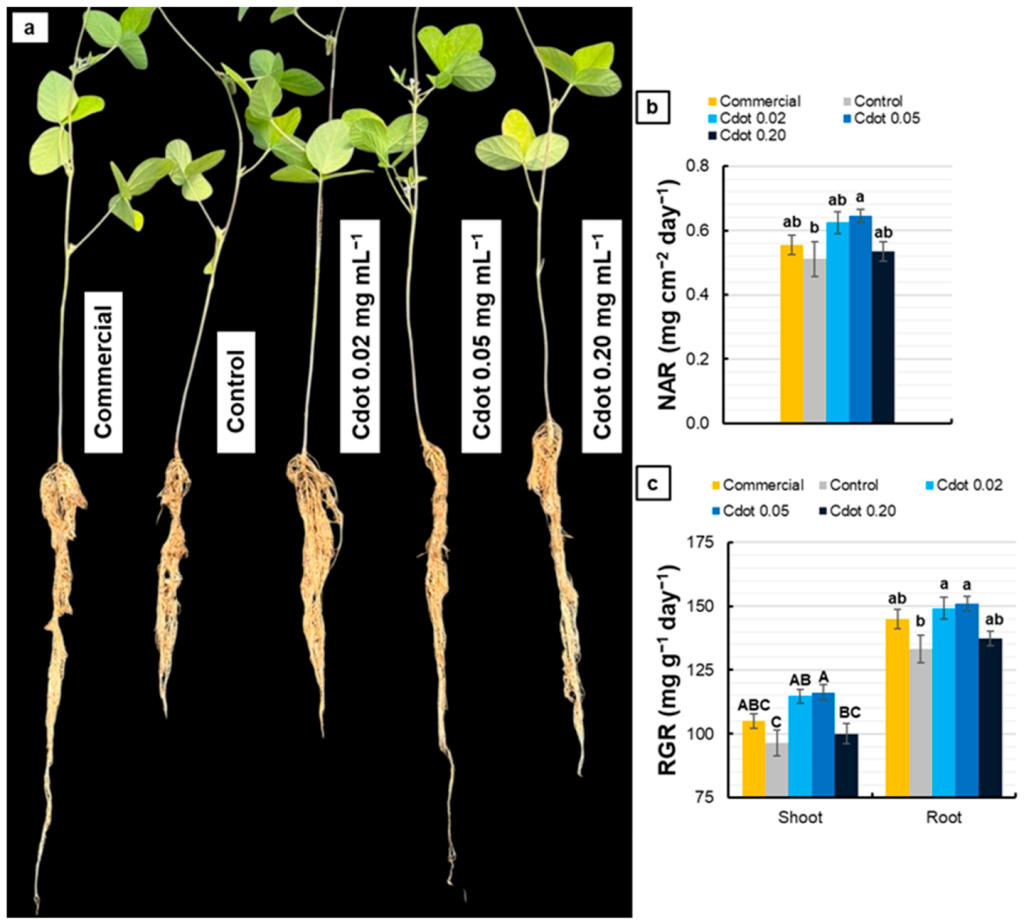
At day 14, the 0.05 mg mL−1 treatment improved stress acclimation, reducing stomatal conductance and transpiration, while sustaining photosynthesis. Growth was significantly enhanced at this concentration, increasing chlorophyll content by 14%, shoot length by 26%, and total dry mass by up to 41% compared to controls.
In conclusion, Cdots at 0.05 mg mL−1 alleviated chronic photoinhibition without increasing dynamic photoinhibition, thus acting as a promising nanobiostimulant that promotes soybean early growth under high-light stress.